Skip to station content
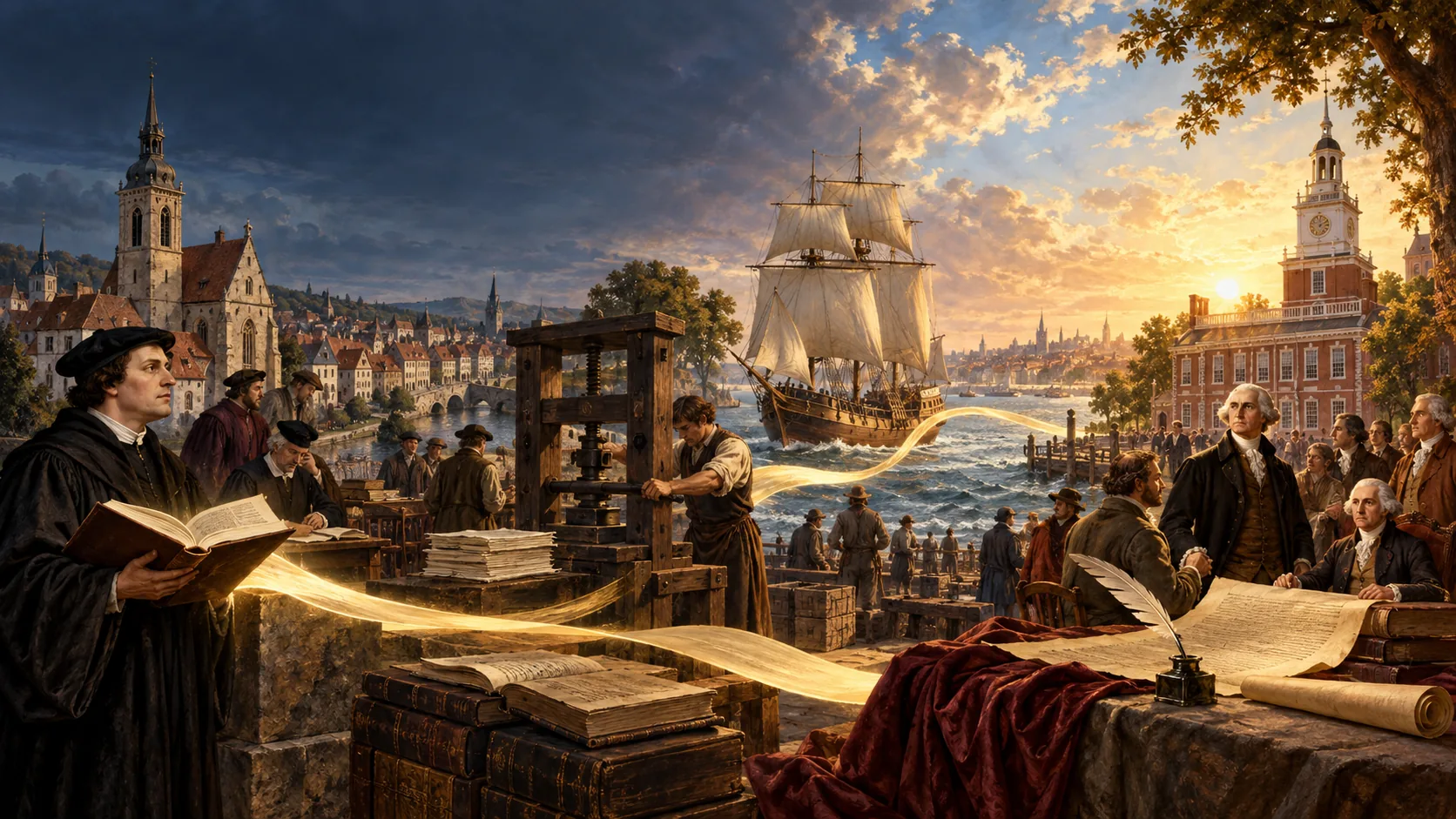
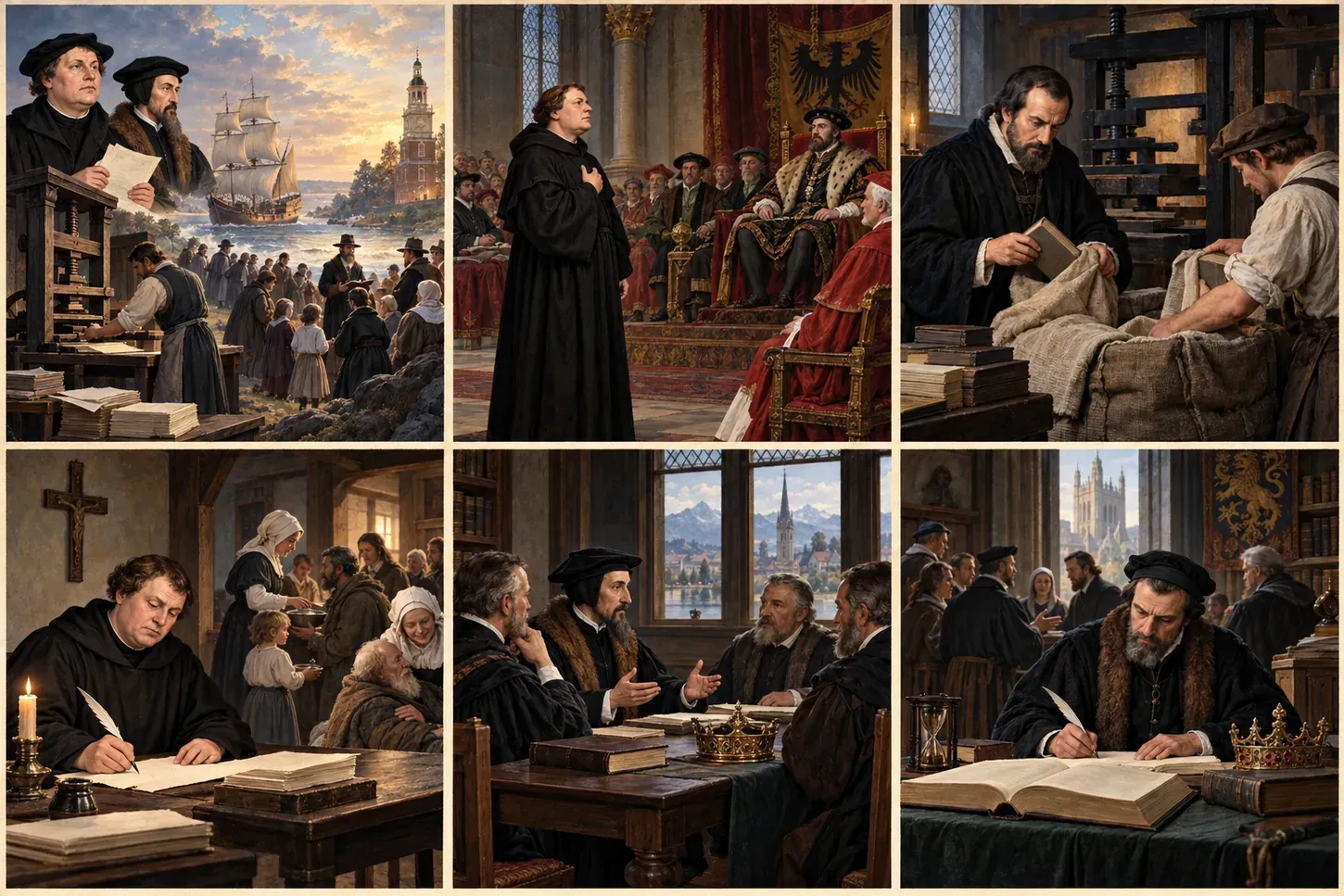
A period-style panorama linking Martin Luther in Wittenberg, a printing press, an Atlantic crossing, and the founding generation in Philadelphia

Station 9 | Faith, Morality, Law, Education, Liberty

The Protestant Reformation

Conscience, Covenant, and the Road to American Liberty

From Wittenberg to Philadelphia

A monk challenged the sale of grace. Printers multiplied his questions. Across generations, Scripture, conscience, covenant, schools, and dissent helped prepare Americans to place rulers beneath law and faith beyond the reach of force.

"Where the Spirit of the Lord is, there is liberty."

2 Corinthians 3:17 (KJV)

Audio Access

Listen to This Station

Hear the complete station read aloud using your device's voice.

Ready to read this station aloud.

Station Overview

A Question That Crossed an Ocean

First Spark

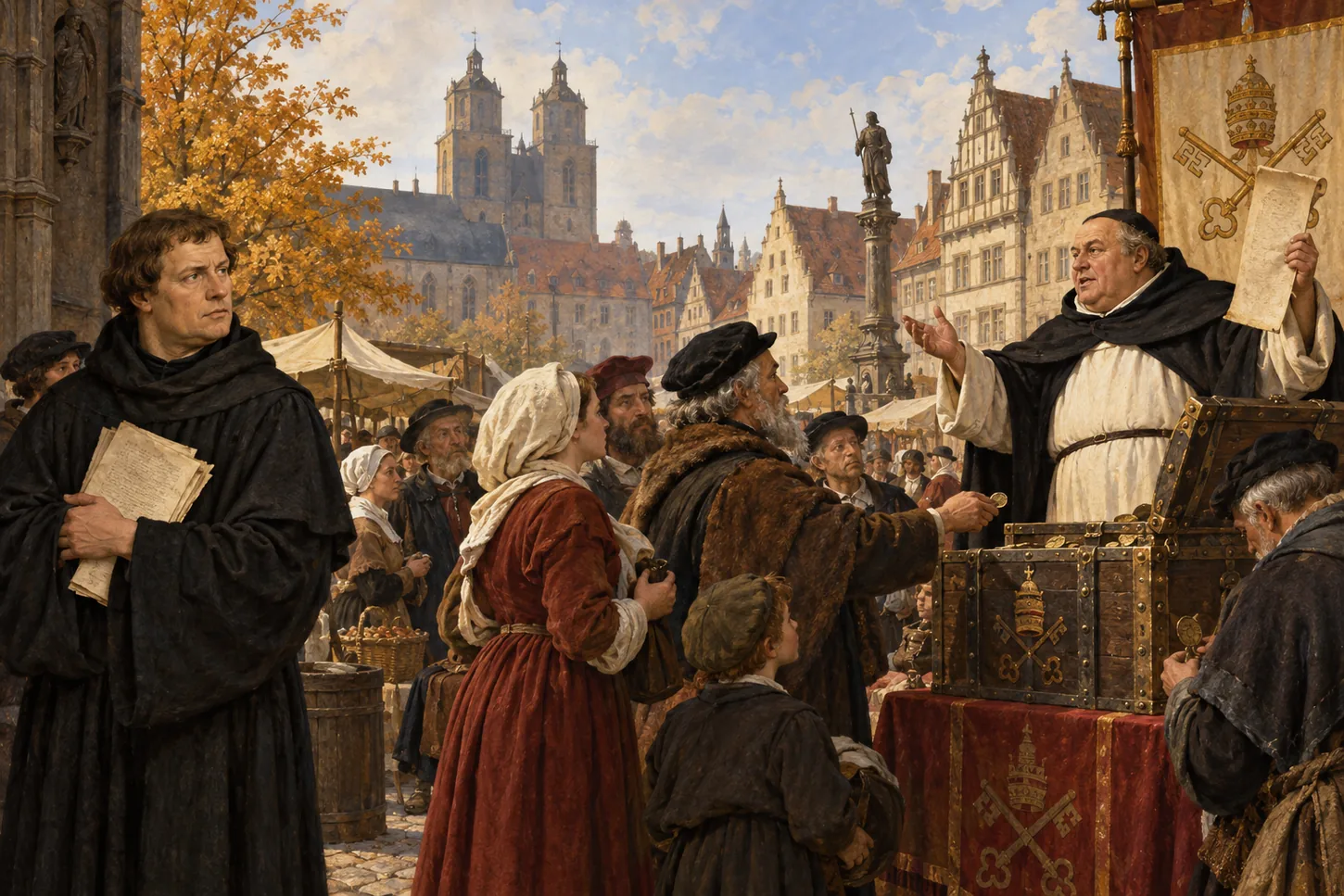
Picture a crowded marketplace in 1517. Johann Tetzel has arrived with a cross, banners, a sermon, and a wooden chest. He tells anxious listeners that an indulgence can lessen punishment connected with sin. A husband thinks of his dead wife. A laborer feels the few coins in his hand. Metal strikes the bottom of the chest, and a promise of mercy has begun to sound like a sale.

A few miles away in Wittenberg, Martin Luther hears what people are being taught. As a pastor and professor, he fears that a printed certificate is replacing repentance, faith, and trust in Christ. He also sees money leaving poor households for a campaign tied to church finance. Luther takes up his pen. In ninety-five short propositions, he asks what forgiveness is, who may promise it, and whether giving to a needy neighbor is better than buying an indulgence.

His challenge begins as an argument about repentance and the Gospel, but the questions quickly grow. Who may bind a conscience? May an office silence an argument without answering it? Must a ruler obey a higher law? Should ordinary people read Scripture for themselves?

Those questions travel through printing shops, churches, schools, refugee communities, colonial covenants, pulpits, legislatures, and constitutional conventions. A marketplace dispute becomes the first scene on a long road to American liberty.
F Faith

Scripture stood above every human office, and conviction could not be purchased.

M Morality

Christian freedom joined liberty to duty, service, and love of neighbor.

L Law

Magistrates held office in trust, beneath covenant and higher law.

E Education

Bibles, schools, printers, and colleges formed a people prepared to reason.

R Liberty

Dissenters widened conscience from a plea for toleration into a protected right.

"And ye shall know the truth, and the truth shall make you free."

John 8:32 (KJV)

The Big Idea

A Religious Reform With Political Consequences

The Reformation did not begin with a plan for a republic. It began with a question about the Gospel.

That distinction matters. If we make Luther into an eighteenth-century democrat or republican, or Calvin into an architect secretly sketching the United States Constitution, we lose the real story. The Reformers lived amid emperors, princes, and established churches. Their work began in that world and opened questions later generations carried much farther.

Yet their theological struggle changed the questions Europeans were prepared to ask. If Scripture may judge a pope, may a higher law also judge a king? If faith requires conviction, can belief be commanded by a magistrate? If Christians stand equal before God, what does office mean? If rulers and people bear covenant duties, what happens when a ruler breaks trust? If every household should know God's Word, how widely must education spread?

Ideas moved from a reformer's desk through generations of debate, books, sermons, schools, churches, and civic experiments before they reached the American founding. Luther emphasized Scripture and the liberty of faith. Calvin treated civil government as a God-given but bounded office and allowed designated magistrates to oppose royal tyranny. Protestants facing civil conflict developed fuller arguments about covenant and resistance. Congregations practiced election and written agreement. Dissenters carried the case for conscience farther still.

America became one of the places where those arguments met.

In 1765, eleven years before independence, John Adams looked backward and named the Reformation as a turning point. He wrote that God raised champions who began and conducted it. Then came his bridge to America:

As knowledge spread, Adams wrote, "ecclesiastical and civil tyranny" lost strength. He did not claim one cause. "It was not religion alone," he carefully added, but also "a love of universal Liberty" that peopled America.

That is this station's central claim: the Reformation helped form the people, practices, questions, and moral language from which America's founding documents emerged.

Christian liberty is not permission to do whatever we please. Luther's first great liberty was the sinner's freedom from condemnation through Christ. That freedom turns outward in love. The conscience is not sovereign; it answers to God and truth. The magistrate is not sovereign over the soul; civil office has limits.

"For, brethren, ye have been called unto liberty; only use not liberty for an occasion to the flesh, but by love serve one another."

Galatians 5:13 (KJV)

Freedom therefore stands between two errors: tyranny from above and license from within. The Christian citizen resists both.

Reformation ideas travel through Scripture, printing, covenant, and conscience toward American liberty

The Journey

From Wittenberg to Philadelphia

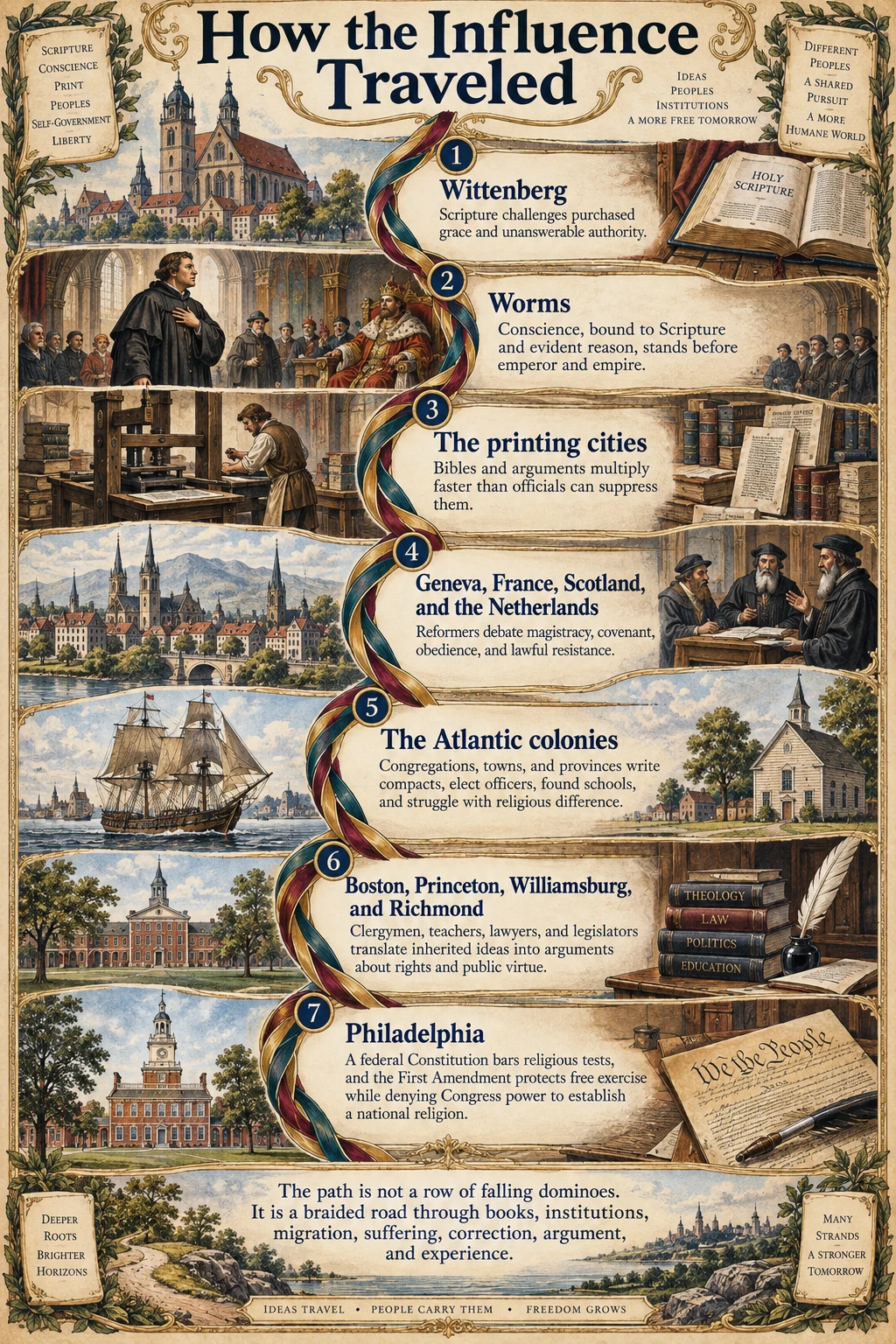
The path is a braided road through books, institutions, migration, courage, argument, and experience.

Illustrated route showing how ideas traveled from Wittenberg and Worms through printing cities, Reformed Europe, Atlantic colonies, and Philadelphia
How the influence traveled across generations Tap or click the infographic to open it full size

The Reformers opened the argument; resistance writers made rulers answerable; colonists practiced covenant government; dissenters enlarged conscience; and Americans transformed that inheritance into constitutional liberty.

I. Faith

The Word Above the Powerful

Martin Luther watches Johann Tetzel sell indulgences beside a wooden chest in a crowded German marketplace
Wittenberg, 1517: an indulgence chest, a pastor's protest, and a question no office could silence

The Reformation's first liberty was not political independence. It was the sinner's freedom to receive salvation as God's gift. But when reformers insisted that God's Word could judge the most powerful offices on earth, a political question waited nearby: if no church leader is above truth, why should any ruler be above law?

"So then faith cometh by hearing, and hearing by the word of God."

Romans 10:17 (KJV)

The Pardon Seller and the Monk

A procession enters a German town. At its center is Johann Tetzel, a gifted preacher sent to promote indulgences. A cross is raised. A chest is set in view. Families gather because the subject is urgent: sin, punishment, and the fate of loved ones who have died. Tetzel's message makes an indulgence certificate feel like something a coin can secure.

Charles Carleton Coffin turns that world into a lively scene in The Story of Liberty. In his telling, a man buys an indulgence for a robbery he plans to commit. He later robs Tetzel and presents the paper as his pardon. The tale captures the moral shock at the heart of the controversy: what happens when a paper promise seems to excuse sin before it is even committed?

In Wittenberg, Martin Luther hears parishioners speak as though their certificates have settled everything. He is a monk, professor, and pastor who has wrestled deeply with guilt and grace. The reports trouble him. If people trust a purchase instead of repentance and Christ, he believes their souls are being misled. If scarce household money goes into a chest while a neighbor needs bread, Christian mercy has been turned upside down.

Luther answers with the Ninety-Five Theses. Thesis 32 warns anyone who treats a letter of pardon as assurance of salvation. Thesis 36 says that a truly repentant Christian receives remission even without such a letter. Thesis 43 goes directly to the marketplace choice: giving to the poor or lending to the needy is better than purchasing an indulgence.

On October 31, 1517, Luther sends the theses to Archbishop Albrecht of Mainz and calls for debate. Then the printing press takes over. Printers copy the Latin text, translators put it into German, and sheets pass from hand to hand. A local protest races across Europe before Luther can guide its course.

The first spark is the question Luther places before the public: Can an office sell what belongs to God, and can authority answer honest argument with anything less than truth?

Why it matters Liberty's road began when grace was separated from money and religious claims were opened to examination.

Martin Luther stands before Emperor Charles V and the assembled Diet of Worms

A Conscience Before an Empire

Four years later, Luther rides into the imperial city of Worms. Crowds press near the road. Inside the assembly hall wait princes, church officials, and the young Emperor Charles V. Luther's books have been stacked where everyone can see them. The question is simple: Are these yours, and will you take back what you wrote?

Luther asks for time. He spends the night weighing the demand, then returns to the hall. He does not claim that every private feeling is true. He says his conscience must answer to Scripture and clear reason:

"Unless I am convicted by testimony of Scripture or by evident reason ... my conscience is captive to the Word of God. Therefore I cannot and will not recant."

Martin Luther at the Diet of Worms, 1521

Luther's conscience is not a throne for personal preference. It is captive, bound to what he believes God has revealed and open to evident reason. Yet the scene announces that an institution cannot simply command inward assent. Authority must answer truth with truth.

The Edict of Worms condemned Luther, prohibited his writings, and ordered that no one print, possess, buy, or sell them. The edict reveals why the moment mattered. If books could be forbidden and conscience compelled by decree, then control of doctrine and control of public thought stood very close together.

Generations of Protestants remember Worms as a picture of conscience refusing to surrender merely because earthly power demands it. The scene becomes a lasting part of the moral imagination that crosses the Atlantic.

Why it matters Conscience is not a license to invent truth; it is the duty to obey truth above intimidation.

William Tyndale's English New Testaments are concealed inside cloth bales for a dangerous journey

The Book Hidden in Cloth

Across the Channel, William Tyndale dreamed of an English Bible ordinary people could understand. Denied support in England, he worked on the Continent. In 1526, printers at Worms produced his New Testament from Greek into English.

The books were small enough to hide. Copies traveled down the Rhine, disappeared into bales of cloth, crossed the water, and entered England as contraband. Officials bought and burned them. Readers wore them out. Only a few copies of the 1526 edition survive.

Tyndale did not survive. Betrayed near Antwerp, he was executed for heresy in 1536. Yet his language outlived the stake. Large portions of his translation later passed into the King James Bible, whose cadences filled colonial homes, churches, schools, speeches, and political arguments.

A vernacular Bible did more than increase private devotion. It trained readers to compare a sermon with a text, a law with a moral command, and a ruler's claim with a standard beyond the ruler. Protestant readers disagreed intensely, and their debates weakened the idea that one human authority could permanently close every question.

The plowboy, craft worker, mother, apprentice, and child became people who should know the text rather than receive every conclusion secondhand.

Why it matters When people can read the standard for themselves, authority must increasingly explain rather than merely command.

II. Morality

Free in Christ, Bound in Love

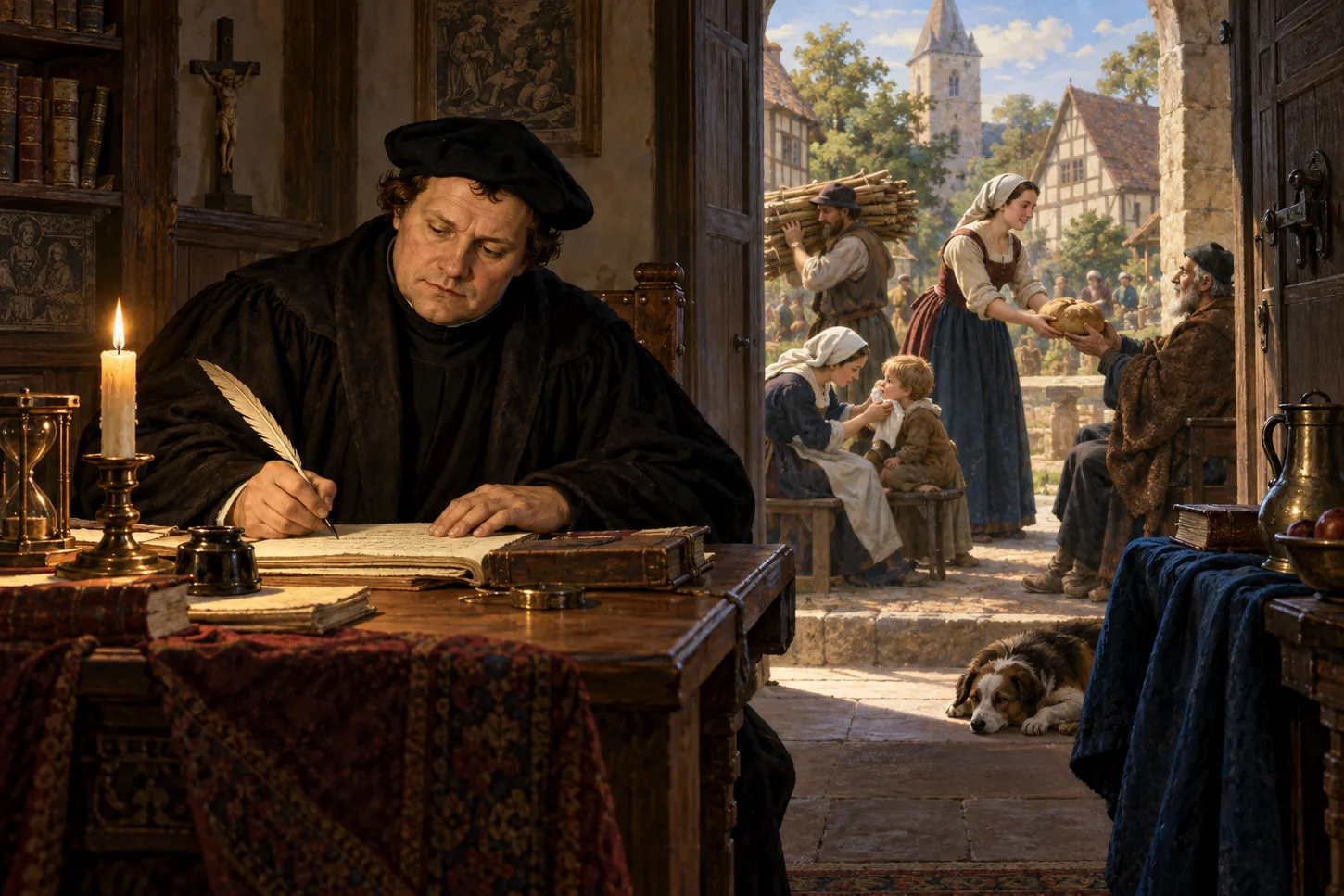
Martin Luther writes by candlelight while neighbors serve the hungry, the young, and the elderly
Luther's paradox joined inward freedom to outward service

Political liberty cannot survive as appetite without restraint. Luther's best-known treatment of freedom joined two sentences that seem to collide. Their tension became one of Protestantism's richest moral inheritances.

"As free, and not using your liberty for a cloke of maliciousness, but as the servants of God."

1 Peter 2:16 (KJV)
Martin Luther writes about Christian freedom while neighbors serve one another

The Freest Lord and the Dutiful Servant

In 1520, Luther sits down to explain what Christian freedom means. Europe is alive with argument, his books are spreading, and the word liberty can easily sound like permission to cast off every duty. He begins The Freedom of a Christian with a paradox:

"A Christian man is the most free lord of all, and subject to none; a Christian man is the most dutiful servant of all, and subject to every one."

Martin Luther, The Freedom of a Christian , 1520

The first sentence lifts a burden. God's favor is not purchased through works or controlled by an earthly intermediary. In Christ, the believer is free. The second sentence points toward the door. Freedom is meant to move outward in love. A person released from trying to earn salvation can give time, courage, goods, and care to a neighbor.

Luther is writing first about spiritual and moral liberty. In a separate work on temporal authority, he draws a boundary around the civil ruler. Earthly government reaches life, property, and outward affairs, he says, but God permits no one but himself to rule the soul.

Imagine the teaching moving from a reformer's page into homes and congregations: liberty and duty belong together. Later Americans will express that union through several traditions, including classical republicanism, natural law, English history, and Enlightenment ethics. Protestant churches add a repeated lesson of their own: people fit for freedom must practice self-command, truthfulness, stewardship, courage, and love of neighbor.

Why it matters Christian liberty is not the absence of obligation. It is the power to serve without slavery to fear or selfish desire.

III. Law

Rulers Under Covenant

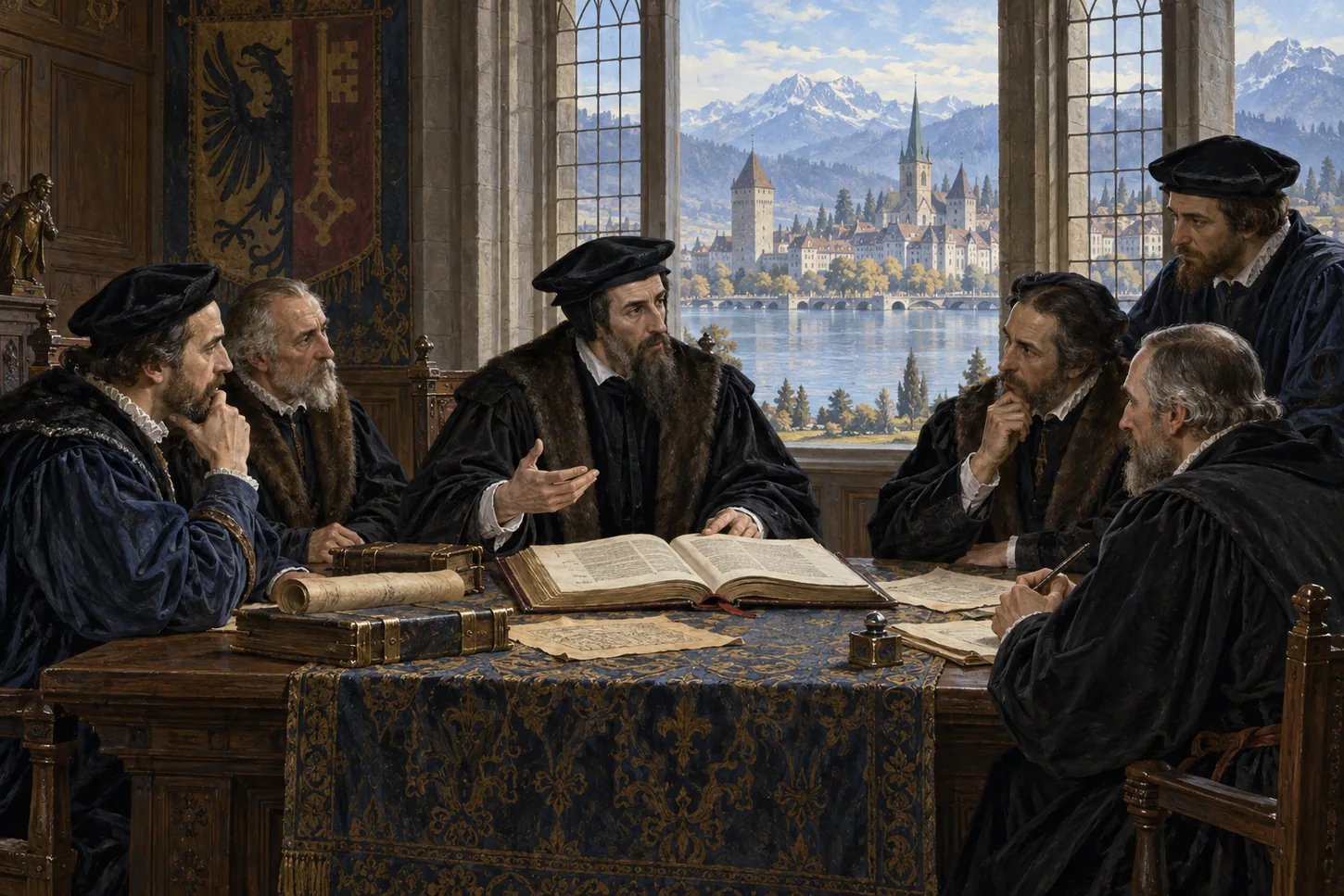
John Calvin speaks with magistrates gathered around a council table in Geneva
A lawful office was a trust with duties, limits, and guardians

Medieval Europe already possessed legal restraints, representative bodies, natural-law traditions, and charters such as Magna Carta. The Reformation added urgent arguments about covenant, office, conscience, obedience, and the fallibility of rulers to that inheritance.

"For there is no power but of God: the powers that be are ordained of God."

Romans 13:1 (KJV)

The Reformers read Romans 13 as a command to respect lawful government. The hard question was what to do when the officer ordained to punish wrong became the wrongdoer.

John Calvin confers with magistrates about the limits and duties of lawful government

Calvin Places a Guardrail Around Kings

In Geneva, John Calvin bends over the pages of his Institutes of the Christian Religion. He believes government is ordained by God to preserve justice and order, so he urges obedience to lawful magistrates. But he also knows that power can wander from its purpose. He favors arrangements in which several rulers can "mutually assist, instruct, and admonish each other."

Near the end of his discussion, Calvin turns to officers he calls "magistrates of the people." Their public duty is to restrain royal willfulness. If they watch a king oppress the weak and remain silent, he writes, they betray "the liberty of the people" placed in their care.

Calvin is speaking to lawful officers who already hold responsibility, not calling every angry individual into revolt. His focus is office, duty, and accountability. That carefully placed guardrail gives later Reformed thinkers a vital question: What must a magistrate do when a supreme ruler violates covenant and law?

Across generations, the answer grows. If political office exists for the people's protection, strength alone cannot make injustice right. Calvin's treatment of magistrates helps later writers describe government as a trust with purposes, boundaries, and guardians who must act when power breaks faith.

Why it matters Authority is legitimate because it serves justice; office does not turn wrongdoing into law.

John Ponet develops a case for lawful resistance and government beneath higher law

From the People, Beneath the Law

In 1556, English Protestant bishop John Ponet opens a dangerous question: Where does a ruler's authority come from? His answer is unusually direct for his age. Kings, princes, and governors, he writes, have authority "of the people." Government exists to protect the commonwealth, and a ruler who destroys that purpose can forfeit his trust.

Two centuries later, John Adams finds Ponet's book and recognizes the argument. He praises it for containing "all the essential principles of liberty" later enlarged by Algernon Sidney and John Locke. A Reformation-era writer has entered a founder's political library by name.

The argument keeps moving. In 1579, a book published under the name "Junius Brutus" asks whether people must obey rulers who defy God and ruin the commonwealth. Vindiciae contra tyrannos , a defense of liberty against tyrants, describes one covenant among God, king, and people and another between king and people. "It was the people who made the king," the treatise declares, "and not the king the people." The community acts through its estates, officers, and representative magistrates.

John Knox in Scotland and Samuel Rutherford's later Lex, Rex add their voices. The Dutch Act of Abjuration of 1581 declares that a prince exists for his subjects and becomes a tyrant through persistent oppression. Long before 1776, Atlantic Protestants are asking whether every public office rests upon public trust.

Why it matters Resistance theory grew from the claim that rulers are trustees beneath law, not owners above it.

Mayflower passengers sign their civil covenant in the ship's crowded cabin

A Covenant on a Rolling Ship

November winds rock the Mayflower off Cape Cod. The passengers have reached a coast north of the territory named in their patent, and uncertainty spreads below deck. Before anyone goes ashore, forty-one adult men gather around a short agreement.

They write that, "in the Presence of God and one another," they will "covenant and combine" into a "civil Body Politick." They promise to make "just and equal Laws" for "the general Good" and to obey the laws they make together. They still call themselves loyal subjects of King James, but they meet an immediate danger by forming civil order through mutual promise.

The word covenant is familiar to Separatist believers. They form a church by pledged agreement, with members and officers bound to shared duties. Now that habit moves into civic life. People bind themselves, create offices, and accept laws directed toward a common good.

The Compact is brief because the shore is waiting and survival demands action. Its lasting power lies in the scene itself: before building houses, the passengers build a political promise.

Why it matters Self-government begins with mutual obligation - people accepting both a voice in law and a duty beneath it.

Thomas Hooker preaches that civil authority rests on the free consent of the people

Free Consent Beside the Connecticut River

On May 31, 1638, the General Court gathers in Hartford and hears the Reverend Thomas Hooker preach about choosing magistrates. A listener's pen preserves a remarkable proposition:

"The foundation of authority is laid, firstly, in the free consent of people."

Thomas Hooker sermon notes, 1638

Hooker's hearers believe God ordains civil government. His point concerns the human placement of office: the people choose magistrates and can define the powers they entrust to them.

Seven months later, the freemen of Hartford, Windsor, and Wethersfield adopt the Fundamental Orders of Connecticut. The preamble invokes divine providence, Scripture, peace, and the liberty of the Gospel. Then the document becomes wonderfully practical. It provides for annual elections, town deputies, regular procedures, and a General Court able to make and repeal laws. If a governor refuses to call a needed court, the freemen have a way to call it.

Hooker's sermon and the Orders now stand beside one another. Free consent, election, representation, written limits, and accountability move from spoken principle into public practice.

Why it matters Covenant became constitutional when communities wrote down who could govern, how officers were chosen, and where power stopped.

IV. Education

A Reading People Can Question Power

A family reads a vernacular Bible while a printer and schoolchildren spread learning
Vernacular Scripture, printing, schools, and colleges formed generations of readers

Once reformers demanded that ordinary Christians know Scripture, ignorance became more than a private disadvantage. It became a public danger. A community that expected people to discern truth, choose officers, keep covenants, and hold rulers accountable needed readers.

"Wisdom is the principal thing; therefore get wisdom: and with all thy getting get understanding."

Proverbs 4:7 (KJV)
Children study Scripture and letters in an early Massachusetts colonial school

The Schoolmaster Against the Old Deluder

In 1647, Massachusetts lawmakers look at a colony of scattered towns and see a public danger: children who cannot read. They describe ignorance in deliberately theological language. It has been the work of "that old deluder, Satan" to keep people from knowledge of the Scriptures, formerly by keeping them "in an unknown tongue."

Their remedy was a school.

A town with fifty households was to appoint someone to teach children to read and write. A town with one hundred households was to establish a grammar school capable of preparing young people for the university.

The chain of thought is plain: Scripture should be known; knowledge requires literacy; literacy requires institutions; the welfare of both "church and commonwealth" depends upon learning. Families, churches, apprenticeships, private teachers, local custom, civic needs, and European precedents all help carry the work.

This is one of the Reformation's clearest American consequences. A Bible translated for the household helped create a school expected in the town. That school prepared not only ministers, but clerks, merchants, lawyers, legislators, and voters able to read laws and arguments.

Why it matters A free society needs citizens who can examine a claim, remember a covenant, and read the law that governs them.

A Pilgrim family gathers around a Geneva Bible in their colonial home

The Bible in a Pilgrim's Hand

In 1560, English reformers living in Geneva lift the first complete copies of a new English Bible from the press. It is compact enough for a household, clear enough for family reading, divided into verses, and filled with notes. Before the King James Bible gradually replaces it, the Geneva Bible becomes a treasured companion of many Puritans and Separatists.

Imagine one of those Bibles wrapped for an Atlantic voyage. When the cover opens in a colonial home, parents and children enter stories of covenant, deliverance, law, judges, kings, prophets, exile, and restoration. In church, sermons connect those stories to the duties of communities and rulers. At the table, a reader can follow a verse and then study the note beside it.

The shared text gives a governor, minister, parent, child, craft worker, and laborer a common world of words. They may argue over its meaning, but they can enter the argument. Phrases learned in childhood later rise again in petitions, sermons, speeches, and public documents.

The Bible in a Pilgrim's hand helps form an imagination able to judge public power within a moral story larger than the state.

Why it matters A text shared across households can become a common language for testing both private character and public power.

John Witherspoon teaches James Madison and other students inside Nassau Hall

The Scotsman in Nassau Hall

When John Witherspoon arrived from Scotland in 1768 to lead the College of New Jersey, students placed a small light in every window of Nassau Hall. He brought his family, a Reformed Presbyterian inheritance, an Edinburgh education, and hundreds of books.

Witherspoon taught theology, history, rhetoric, moral philosophy, and political thought. He did not seal students inside one intellectual school. His Princeton joined Reformed Christianity with Scottish Enlightenment learning, classical sources, common-law traditions, and vigorous debate.

Among his students is James Madison, who graduates in 1771 and remains for further study. Nine Princeton alumni later attend the Constitutional Convention; five have been Witherspoon's students. The classroom forms a real institutional bridge from the Scottish Reformed world to American statesmanship.

On May 17, 1776, Witherspoon preached that America's cause was "the cause of justice, of liberty, and of human nature." He warned that civil and religious liberty could not easily be separated:

"There is not a single instance in history in which civil liberty was lost, and religious liberty preserved entire."

FOUNDING VOICE: John Witherspoon, The Dominion of Providence , 1776

Weeks later he entered the Continental Congress. He became the only clergyman and college president to sign the Declaration of Independence.

Why it matters Ideas reach constitutions through teachers, students, books, debate, and the lifelong work of turning principle into practice.

V. Liberty

From Defended Conscience to a Protected Right

Religious refugees arrive in a welcoming colonial city built around conscience and peace
Refuge, petition, persuasion, and law widened liberty of conscience

The first Reformers defended conscience. Later Protestants carried the principle farther, especially dissenters who understood from experience how precious protection could be. Their appeals helped shape America's strong tradition of religious liberty.

"Who art thou that judgest another man's servant? to his own master he standeth or falleth."

Romans 14:4 (KJV)
The banished Roger Williams receives shelter from his Wampanoag neighbors in winter

The Banished Minister's Lively Experiment

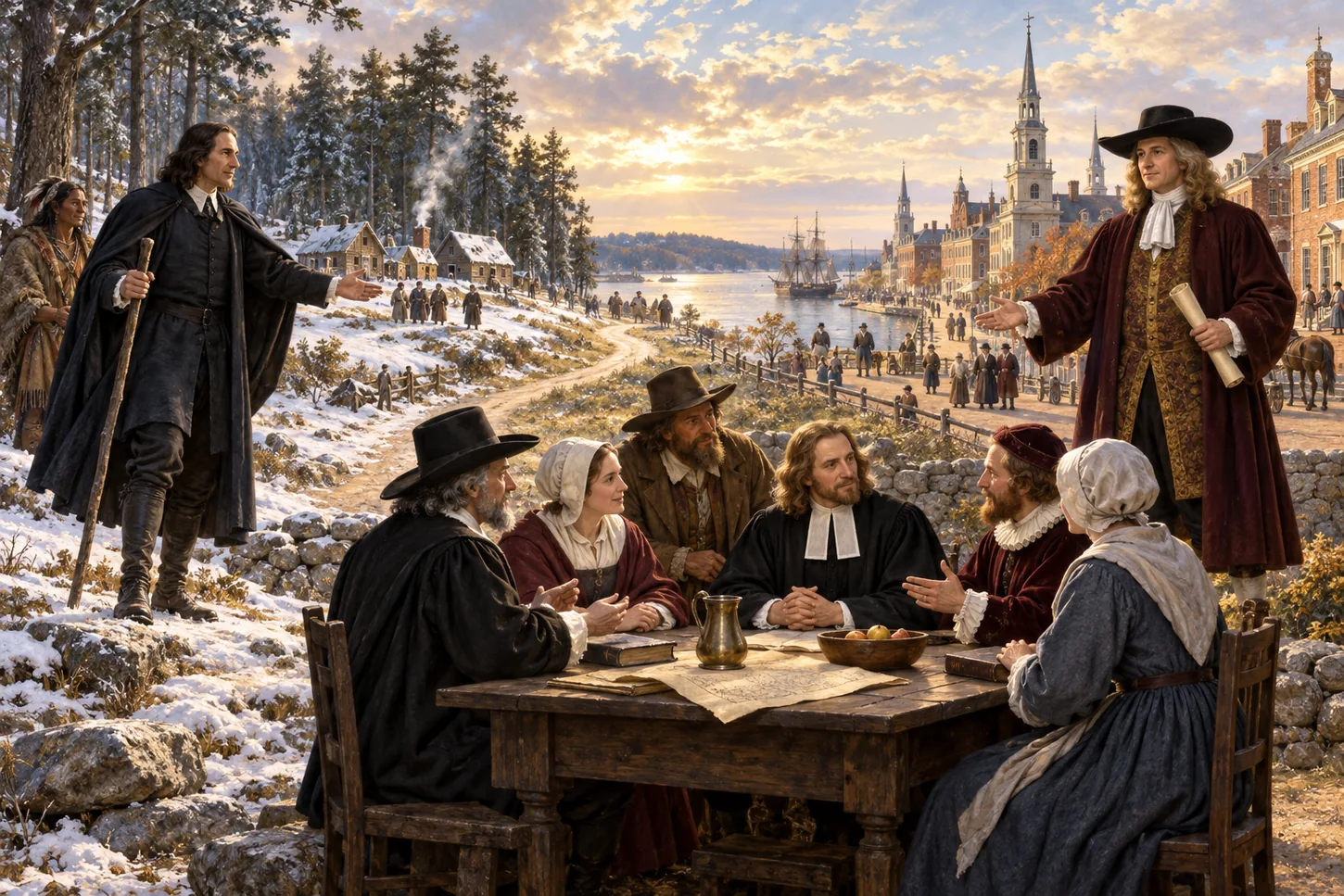
Snow lies across the New England woods when Roger Williams leaves Massachusetts. The colony has banished him for teachings its leaders consider dangerous, including his belief that civil magistrates should preserve public order but leave worship and doctrine to conscience. He walks into winter without a settled home.

A Wampanoag hunting party is believed to have found Williams and brought him to Massasoit, who shelters him through the brutal winter. In spring, Williams crosses into Narragansett country, negotiates with the sachems Canonicus and Miantonomi, and begins a settlement beside Narragansett Bay. He names it Providence, grateful for God's care. There he helps build a community where civil peace does not depend on everyone worshiping in the same way.

In 1644, Williams carries the argument into print with The Bloudy Tenent of Persecution for Cause of Conscience. Forced uniformity, he writes, produces violated conscience, hypocrisy, persecution, and civil conflict. His protection reaches far beyond his own convictions to consciences he calls "Paganish, Jewish, Turkish, or anti-christian."

Williams makes his case from Christian belief. Genuine faith cannot be created by a sword, and civil officers have not been given rule over the soul. Nearly twenty years later, Rhode Island's charter of 1663 names the colony a "lively experiment": a flourishing civil state may stand "with a full liberty in religious concernments."

The winter traveler has helped turn a dissenter's plea into the governing promise of a colony. Rhode Island will test before the world whether strong faith, religious variety, and civil order can live together.

Why it matters Liberty of conscience became durable when it moved from a dissenter's plea into a governing charter.

William Penn presents a frame of government to the diverse people of Philadelphia

Penn Makes the People a Party to the Law

William Penn knows the sound of a prison door. His Quaker preaching has brought punishment in England, and the experience shapes the colony he plans across the Atlantic. He imagines a place where conscience is secure and the people take part in making the laws.

"Any Government is free to the People ... where the Laws rule, and the People are a Party to those Laws."

William Penn, Frame of Government of Pennsylvania , 1682

The same year, Pennsylvania's Great Law calls God the "only Lord of Conscience." Peaceable residents who acknowledge one Almighty God are not to be troubled for conscientious persuasion or forced to attend or support worship against their minds. Penn places two ideas side by side: government is free where law rules with the people's participation, and religion is genuine where conscience is not compelled.

He names his capital Philadelphia, the City of Brotherly Love. Its streets are laid out in a generous grid between the Delaware and Schuylkill Rivers, with public squares and room for a varied people to build. Over the following decades, Quakers, Anglicans, Presbyterians, Baptists, Lutherans, Reformed Christians, Jews, and others make the city a busy place of worship, printing, trade, and debate.

That civic habit matters. Philadelphia becomes the meeting place of the First and Second Continental Congresses, the signing of the Declaration of Independence, and the Constitutional Convention. In the city Penn founded, Americans from different colonies, denominations, and interests learn to deliberate under one roof.

Why it matters Civil liberty and religious liberty grew together when rulers were placed beneath law and conscience outside coercion.

Isaac Backus and fellow petitioners carry their appeal for religious liberty toward James Madison

The Baptist Petition Meets Madison's Pen

Isaac Backus knows religious establishment from the receiving end. New England Baptists can be taxed to support Congregational churches, and a family that refuses may lose property. Backus responds by traveling, preaching, organizing, and gathering names. In 1773 he publishes An Appeal to the Public for Religious Liberty. Religion, he says, is voluntary obedience to God, and force cannot create it.

The next year, Backus brings the complaint to delegates meeting for the First Continental Congress. The cause keeps moving from local meetings to public petitions and from a request for toleration toward a claim of equal right.

In Virginia, the same struggle reaches James Madison. George Mason's 1776 draft declaration speaks of toleration. Madison helps strengthen it into equality: "all men are equally entitled to the free exercise of religion, according to the dictates of conscience." In 1785, when lawmakers consider a tax for Christian teachers, Madison writes his Memorial and Remonstrance. Conscience is unalienable, he argues, because duty to the Creator comes before the claims of civil society.

Madison does not write alone. Eighty petitions reach the legislature with thousands of signatures from several denominations. Baptist and Presbyterian organizing gives public force to a principle Madison states with constitutional precision.

Why it matters A principle becomes public liberty when ordinary people organize, petition, and persuade lawmakers to place it beyond majority control.

Conscience Becomes Constitutional Law

Thomas Jefferson's religious beliefs differed sharply from Luther's, Calvin's, or Witherspoon's. Yet his Bill for Establishing Religious Freedom opened with a theological assertion:

"Almighty God hath created the mind free."

FOUNDING VOICE: Thomas Jefferson, Virginia Bill for Establishing Religious Freedom

The bill rejected coerced worship because force produces hypocrisy and meanness, because fallible rulers may establish their own opinions as the only true ones, and because truth can prevail through free argument. Virginia adopted the statute in 1786.

Then came Philadelphia. The 1787 Constitution created no national church and required "no religious Test" for federal office. In 1789, Madison explained that a proposed amendment would prevent Congress from establishing religion or compelling anyone to worship contrary to conscience. Ratified in 1791, the First Amendment barred laws respecting an establishment of religion or prohibiting its free exercise.

This is the clearest Wittenberg-to-Philadelphia bridge: a dispute over coerced belief became, across generations, a constitutional limit on coercive power.

Why it matters Conscience became an American liberty when the law denied the national government authority to command faith.

Founding Voices

Founders in the Reformation's World

American founders study books, sermons, and maps on the road toward independence
Books, sermons, schools, and dissent shaped the world in which the founders learned to reason

The phrase "products of the Reformation" is useful when it describes the world that formed the founders. The colonies' dominant churches, colleges, sermons, Bible reading, public fasts, dissenting movements, and arguments over establishment were heirs of the Reformation. The founders brought varied religious backgrounds to that shared world. They included Anglicans, Congregationalists, Presbyterians, Quakers, Baptists, and a Roman Catholic.

Most therefore encountered politics inside a culture already changed by the Reformation, even when they disagreed with Reformation theology. Their own words provide better evidence than modern percentage slogans.

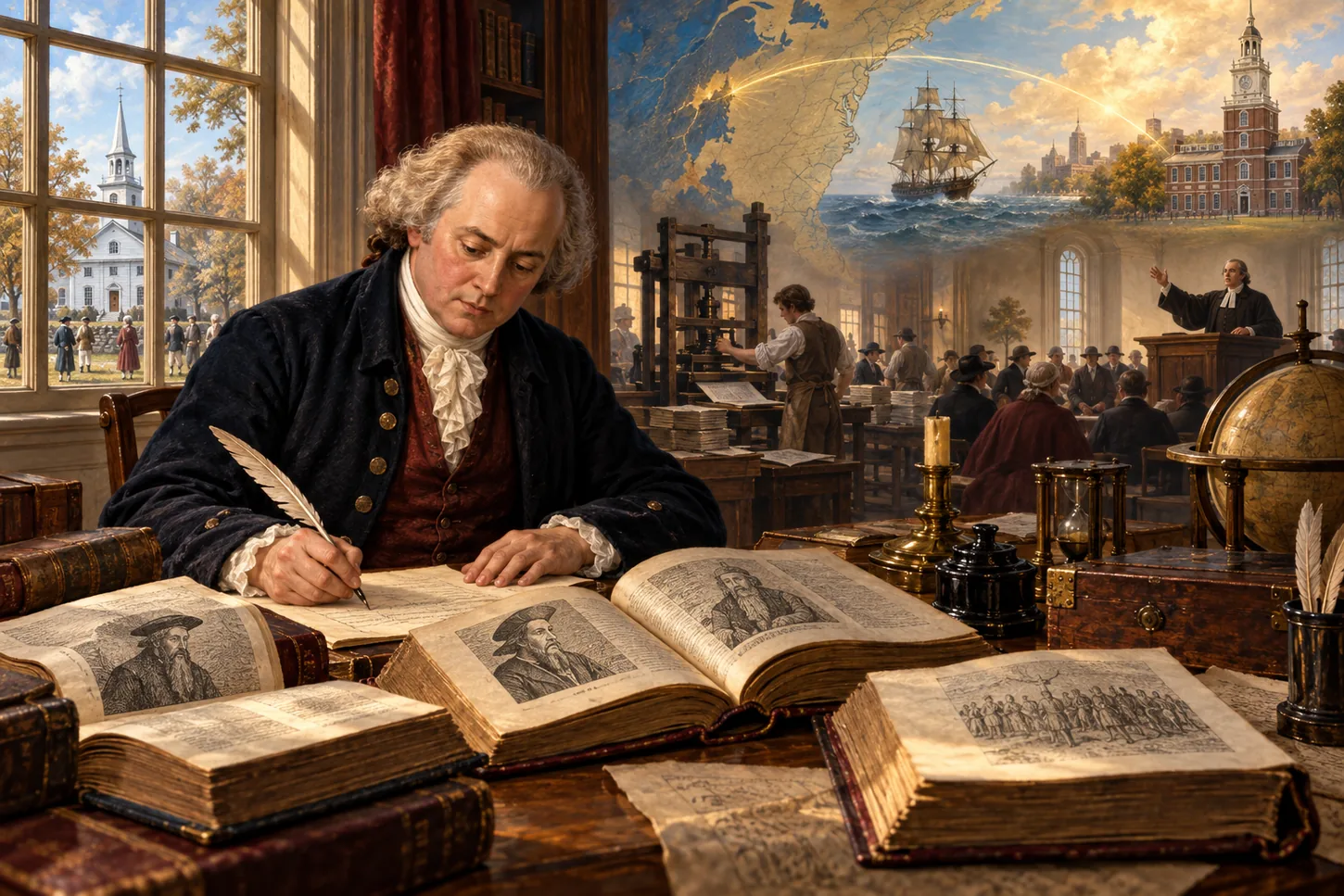
John Adams writes his Dissertation on the Canon and Feudal Law beside books and papers

John Adams Names the Road

In 1765, news of Parliament's Stamp Act runs through the colonies. In Massachusetts, a young lawyer named John Adams takes up his pen for the Boston Gazette. Before arguing about a tax stamp, he looks far back into history.

Adams sees two old systems that have often worked together to keep people submissive: unchecked church authority and feudal power. Both depend upon ignorance. Then he reaches the turning point. "From the time of the reformation, to the first settlement of America," he writes, "knowledge gradually spread in Europe, but especially in England."

Picture the road Adams describes. Reformers open Scripture. Printers multiply books. Readers compare claims. Families cross the Atlantic carrying both faith and a love of liberty. As knowledge spreads, Adams says, "ecclesiastical and civil tyranny" loses strength. Then he writes the line that makes his testimony so important to this station: "It was this great struggle, that peopled America."

Adams explains that religion and liberty traveled together. The settlers were moved by faith, and also by "a love of universal Liberty" and a deep hatred of domination joined to ignorance. He sees several causes meeting in one migration.

In 1813, Adams looks back on the common ground that had united Americans. Recalling a religiously varied assembly of young Philadelphians, he writes that they had been educated in "the general Principles of Christianity" and "the general Principles of English and American Liberty." Those principles, he adds, had united American parties strongly enough to "assert and maintain" independence.

Why it matters A leading founder explicitly connected the Reformation, spreading knowledge, American settlement, and the growth of liberty.

Jonathan Mayhew delivers a sermon about liberty and resistance to tyranny

A Sermon Everyone Read

On January 30, 1750, Jonathan Mayhew climbs into the pulpit of Boston's West Church. On a day the Book of Common Prayer uses to remember Charles I as a saint and martyr, Mayhew rejects the conventional Anglican lesson of unlimited submission.

Opening Romans 13, he argues that civil authority is a trust for the common safety and welfare. Commands contrary to God's will are "null and void," and under severe oppression resistance may become a duty. Protestant Scripture-reading, Puritan memory, natural rights, English resistance thought, and the crisis of his own day meet in one sermon.

The printed sermon travels far beyond the room. In 1818, John Adams tells Hezekiah Niles that Mayhew's discourse "was read by every Body" and revived ancestral opposition to tyranny "in Church and State." The Revolution, Adams says, was the work of many minds and many years. Mayhew's sermon was one of its early sparks.

Here is the path in plain view: a named sermon, a founder's memory, and an idea traveling from pulpit to public argument.

Why it matters Before muskets carried the Revolution, sermons taught hearers to ask whether power was fulfilling the moral purpose for which it existed.

John Witherspoon carries Reformation convictions from the pulpit into the Continental Congress

Witherspoon Crosses the Atlantic

John Witherspoon crosses the Atlantic in 1768 as a Scottish Presbyterian minister and scholar. At Princeton, his classroom fills with future ministers, lawyers, and public servants. He teaches Reformed theology beside moral philosophy, classical rhetoric, public law and politics, and the learning of the Scottish Enlightenment.

In May 1776, Witherspoon enters the pulpit as independence approaches. His sermon joins Providence, moral accountability, civil liberty, and religious liberty. Soon his public service carries those convictions into the Continental Congress, where he signs the Declaration of Independence.

"God grant that in America true religion and civil liberty may be inseparable."

FOUNDING VOICE: John Witherspoon, 1776

Witherspoon immediately warned his hearers not to confuse true religion with railing at opponents or angry sectarian competition. Liberty, in his telling, required inward principle and outward conduct.

Why it matters Reformation ideas reached the founding through living teachers who joined inherited faith to new learning and public responsibility.

A Chorus of Founding Voices

John Adams on the Reformation - "From the time of the reformation, to the first settlement of America, knowledge gradually spread." Source note 26.

Samuel Adams on the source of liberty - "The right to freedom being the gift of God Almighty, it is not in the power of Man to alienate this gift." Source note 44.

John Witherspoon on linked liberties - "There is not a single instance in history in which civil liberty was lost, and religious liberty preserved entire." Source note 28.

James Madison on prior duty - Religion is a duty "precedent, both in order of time and in degree of obligation, to the claims of Civil Society." Source note 31.

Thomas Jefferson on an uncoerced mind - "Almighty God hath created the mind free." Source note 32.

George Washington on conscience as right - Worship according to conscience was "not only among the choicest of their blessings, but also of their rights." Source note 43.

Benjamin Franklin on Luther's memory - In 1749 Franklin marked the anniversary of Luther, "who struck the great blow to papal tyranny in Europe." Source note 46.

The Long Road

From 1517 to 1791

  1. 1517

    Luther circulates the Ninety-Five Theses against abuses surrounding indulgences.

  2. 1520

    The Freedom of a Christian joins liberty to faith and loving service.

  3. 1521

    At Worms, Luther refuses to recant unless answered by Scripture or evident reason.

  4. 1526

    Tyndale's printed English New Testament begins crossing into England.

  5. 1536

    Calvin publishes the first edition of the Institutes , later enlarged to include fuller teaching on civil government.

  6. 1556

    John Ponet argues that rulers receive authority from the people for the commonwealth's good.

  7. 1579

    Vindiciae contra tyrannos frames ruler and people through covenant and conditional obedience.

  8. 1581

    The Dutch Act of Abjuration declares that an oppressing prince may become a tyrant.

  9. 1620

    Mayflower passengers covenant into a civil body politic for just and equal laws.

  10. 1638-1639

    Hooker preaches consent; Connecticut's Fundamental Orders establish elections and representation.

  11. 1644

    Roger Williams publishes The Bloudy Tenent ; Samuel Rutherford publishes Lex, Rex.

  12. 1647

    Massachusetts orders towns to provide schooling so Scripture will not be hidden by ignorance.

  13. 1663

    Rhode Island's charter protects a lively experiment in religious liberty.

  14. 1682

    William Penn joins rule of law and popular participation to protection for conscience.

  15. 1750

    Jonathan Mayhew preaches that authority is a trust for the common good.

  16. 1765

    John Adams links Reformation, spreading knowledge, American settlement, and liberty.

  17. 1773-1776

    Backus appeals for religious liberty; Witherspoon preaches for civil and religious liberty; Virginia protects free exercise.

  18. 1786

    Virginia adopts Jefferson's Statute for Religious Freedom.

  19. 1787-1791

    The Constitution prohibits federal religious tests; the First Amendment protects free exercise and bars national establishment.

The pattern

Across 274 years, a question raised at Wittenberg grows through books, covenants, schools, sermons, charters, and public action until conscience receives constitutional protection.

Ideas in Motion

What the Reformation Gave and America Developed

Reformation inheritance American expression How the idea grew
Scripture above human office Appeals to higher law and Creator-given rights Natural law, common law, and Enlightenment reasoning joined the argument
Conscience bound to God Free exercise and resistance to compelled worship Dissenters widened the principle into protection for their neighbors
Christian liberty Liberty joined to duty and virtue Spiritual freedom helped teach self-government and service
Covenant Compacts, written constitutions, and mutual obligation Congregational practice joined legal and philosophical ideas of contract
Fallen human nature Suspicion of unchecked power Political experience turned moral realism into accountable institutions
Lesser magistrates Lawful resistance to tyranny Later writers expanded a duty of office into a language of public trust
Vernacular Scripture Literacy, schools, and public argument Homes, churches, towns, and colleges formed generations of readers
Protestant dissent Disestablishment and protected conscience Appeals, petitions, charters, and laws carried conscience into public life

The relationship is best pictured as a seedbed, not a blueprint. A seed can shape what grows without determining every branch. American constitutional liberty developed in soil enriched by Reformation ideas and practices, while drawing nourishment from many other roots.

Closing Takeaway

The Road Reaches Philadelphia

A symbolic road links Wittenberg's church door and printing press to Philadelphia's founding hall

A monk questioned an indulgence. A printer multiplied the question. A translator placed Scripture in ordinary hands. A conscience stood before an emperor. Reformed writers placed rulers beneath covenant and law. Refugees crossed borders and oceans. Colonists promised one another just and equal laws. Towns hired teachers. Dissenters demanded protection not only for their own faith, but eventually for the conscience of a neighbor.

Then Americans write those lessons into the law of a new nation: government receives just power through consent; rights do not come as favors from rulers; no religious test may guard federal office; and Congress may neither establish religion nor prohibit its free exercise.

The road that began in Wittenberg reaches Philadelphia strengthened by Magna Carta, English common law, classical history, natural law, Enlightenment thought, and colonial experience. Many streams meet, and the Reformation is one of the strongest. It has opened the Bible, trained readers, awakened conscience, placed rulers beneath law, inspired covenants, and taught communities to join liberty with duty.

Its great political gift is a durable conviction: no human power is truth's unquestionable master, and the conscience must remain answerable to God rather than commanded by the state.

Memory Line

The Reformation opened the Bible, awakened conscience, and taught that rulers too stand under law.

Gospel Memory Line

Christ frees the conscience from sin so the Christian may serve in love.

Garden Thread

Print carried the Word. Conscience questioned power. Covenant bounded rulers. Liberty gained a law.

Final Reflection

What kind of citizen can preserve liberty?

One who can read. One who can reason. One who will not sell conviction for safety. One who recognizes a law higher than appetite. One who guards the conscience of a neighbor. One who understands that freedom and responsibility grow from the same root.

The Christian response is to remember gratefully, examine truthfully, live courageously, and continue the work faithfully.

Illustrated cover preview for the Station 9 guide

Complete Station Guide | PDF

Carry the Story With You

Read the complete Station 9 narrative, founder quotations, timeline, and documented source notes in the downloadable guide.

Download Station 9 PDF

Source Notes

Follow the Evidence

This station draws on primary documents, founder correspondence, public records, institutional collections, and modern scholarship. Open each group to explore the evidence.

Sources 1-12
  1. King James Bible, 2 Corinthians 3:17; John 8:32; Galatians 5:13; Romans 10:17; 1 Peter 2:16; 1 Thessalonians 5:21; Romans 13:1; Proverbs 4:7; Romans 14:4. Scripture and Gospel framing.
  2. Charles Carleton Coffin, The Story of Liberty , "The Boy-Cardinal," pp. 201-203. A vivid narrative retelling of the marketplace controversy surrounding indulgences.
  3. Martin Luther, Ninety-Five Theses , German History in Documents and Images. Theses 32, 36, and 43; transmission to Archbishop Albrecht; door tradition treated cautiously.
  4. Library of Congress, "Luther the Priest". Original purpose of the theses, print, and growth of the door image in public memory.
  5. German History in Documents and Images, "Luther and Emperor Charles V at the Diet of Worms". Authenticated conscience statement and imperial edict.
  6. Martin Luther, The Freedom of a Christian , Hanover Historical Texts Project. Free-lord and dutiful-servant paradox.
  7. Stanford Encyclopedia of Philosophy, "Martin Luther". Theological liberty, two governments, civil order, and Luther's changing political positions.
  8. Library of Congress, "Let There Be Light: William Tyndale". Printing at Worms, smuggling, execution, and legacy in the King James Bible.
  9. Library of Congress, "Religion and the Founding: America as a Religious Refuge". Geneva Bible, Protestant migration, and the colonial religious setting.
  10. John Calvin, Institutes of the Christian Religion , Book IV, chapter 20, especially sections 8 and 31-32; also the Meeter Center edition.
  11. Constance Lee, "Conscience and the Continuum of Constitutionalism: John Calvin on Civil Government", Oxford Journal of Law and Religion 12 (2023), 34-54. Calvin's bounded offices, mutual duty, and historical context.
  12. Meeter Center for Calvin Studies, John Calvin biography and Servetus context. Calvin, Geneva, and the execution of Michael Servetus.
Sources 13-24
  1. Sebastian Castellio, Against Calvin's Book , written 1554. Protest against killing for doctrine; see also Stanford Encyclopedia of Philosophy, "Toleration".
  2. John Ponet, A Shorte Treatise of Politike Power , 1556; John Adams, Defence of the Constitutions , vol. 6, praising Ponet.
  3. Junius Brutus, Vindiciae contra tyrannos , 1579. Dual covenant, conditional obedience, and action through public officers; authorship remains debated.
  4. Dutch Act of Abjuration, 1581, Declaration Project. A prince exists for the people and may become a tyrant through persistent oppression.
  5. John Knox, Letter to His Brethren in Scotland, 1557; Knox, Appellation , EEBO-TCP; Samuel Rutherford, Lex, Rex , 1644.
  6. Mayflower Compact, Yale Avalon Project; Library of Congress, "The Mayflower Compact". Covenant, civil body politic, and just and equal laws.
  7. Fundamental Orders of Connecticut, Yale Avalon Project; Connecticut History, "The Free Consent of the People". Written procedures, elections, and Hooker's sermon notes.
  8. Massachusetts General Court, "Old Deluder Satan" school law, 1647. Town schools, literacy, Scripture, church, and commonwealth.
  9. Roger Williams, The Bloudy Tenent of Persecution , 1644. Civil peace, religious diversity, and protection for contrary consciences.
  10. Rhode Island Royal Charter, 1663, Rhode Island Secretary of State; U.S. National Park Service, "Winter of 1636" and "Roger Williams: Rebel, Revolutionary, Radical". Wampanoag rescue, Massasoit's shelter, Narragansett negotiation, the founding of Providence, and full liberty in religious concernments.
  11. William Penn, Frame of Government of Pennsylvania , 1682; Pennsylvania Historical and Museum Commission, "The Great Law"; Library of Congress, "William Penn Arrives in America"; National Park Service, People of the City . Rule of law, popular participation, conscience, the City of Brotherly Love, and Philadelphia's growing religious variety.
  12. Isaac Backus, An Appeal to the Public for Religious Liberty , 1773; Library of Congress, "An Appeal for Religious Liberty".
Sources 25-36
  1. Jonathan Mayhew, A Discourse Concerning Unlimited Submission , 1750; Library of Congress, "Religion and the American Revolution".
  2. John Adams, A Dissertation on the Canon and the Feudal Law , 1765, Founders Online. Direct link among Reformation, spreading knowledge, American settlement, and liberty.
  3. John Adams to Hezekiah Niles, 13 February 1818, Founders Online. Mayhew's sermon was read widely and revived opposition to tyranny in church and state.
  4. John Witherspoon, The Dominion of Providence Over the Passions of Men , 1776. Justice, civil liberty, religious liberty, Providence, and public character.
  5. Princeton University Art Museum, "John Witherspoon"; Princeton University, Witherspoon naming committee report; Princeton and Slavery Project, "John Witherspoon". Teaching, Madison, founding service, and historical context.
  6. Virginia Declaration of Rights, 1776, National Archives. Free exercise according to conscience and Christian forbearance.
  7. James Madison, Memorial and Remonstrance Against Religious Assessments , 1785, Founders Online. Prior duty to the Creator, unalienable conscience, majority power, and tyranny.
  8. Thomas Jefferson, Bill for Establishing Religious Freedom, 1779; Virginia Statute for Religious Freedom, 1786. A free mind, the limits of coercion, and equal civil capacity.
  9. National Archives, Constitution transcript and Bill of Rights transcript; Founders Online, House debate on the First Amendment.
  10. Library of Congress, Religion and the Founding of the American Republic . Protestant institutions and diversity, refuge, establishments, Revolutionary religion, and the federal settlement.
  11. Nicholas P. Miller, The Religious Roots of the First Amendment , Oxford University Press; John Witte Jr., "Reclaiming the Blessings of Religious Liberty"; John Witte Jr., The Reformation of Rights . Multi-generational influence and qualifications.
  12. World History Institute, October 2023 Journal, "The Reformation: The American Connection". Supplied source used to identify stories and leads; sweeping causal claims and quotations were independently checked.
Sources 37-48
  1. Bill Federer, American Minute, "Luther and the Protestant Reformation's Political Repercussions on America's Founding". Supplied popular overview used as a research lead, not sole authority.
  2. Bill Federer, American Minute, "How the Renaissance and Reformation Led to Revolution". Supplied narrative lead for Calvin, Knox, Witherspoon, and revolutionary memory; numerical and quotation claims independently tested.
  3. American Minute, tagged Renaissance and Reformation index. Supplied background index; its broad civilizational chain was beyond this station's strongest documented claim.
  4. World History Institute, January-February 2019 Journal. Supplied story prompts for Luther, Tyndale, Calvin, and Knox, checked against primary and institutional sources.
  5. World History Institute, Journals Index. Reviewed for Reformation material, including issues on the American connection, defense against tyrants, Pilgrims, and Scotland.
  6. Donald S. Lutz, "The Relative Influence of European Writers on Late Eighteenth-Century American Political Thought", American Political Science Review 78 (1984). Citation study and warning against a single dominant source tradition.
  7. George Washington, letter to the Society of Quakers, October 1789, Founders Online. Worship according to conscience as blessing and right.
  8. Samuel Adams, "The Rights of the Colonists", 1772. Life, liberty, property, consent, and freedom as God's gift.
  9. John Adams to Thomas Jefferson, 28 June 1813, Founders Online. Adams's explanation of the shared principles invoked by a religiously varied Philadelphia assembly and by American majorities in the independence era.
  10. Benjamin Franklin, Poor Richard Improved , 1749, Founders Online. Luther remembered as striking a blow against papal tyranny.
  11. George Washington's Mount Vernon, "Spurious Quotations". Documents why the supposed government, God, and Bible quotation is excluded.
  12. Balthasar Hubmaier, Concerning Heretics and Those Who Burn Them , 1524; University of Chicago, Isaac Backus on church and state; Mark David Hall, "The Reformed Tradition and the American Founding". Radical Reformation, dissent, and scholarly bridge.
Station 9 | The Protestant Reformation | National Garden of the Founders